
The circular water economy reimagines water as a renewable, regenerative resource, with opportunities to reduce waste;, recover water, nutrients, energy, and other valuable resources;, and regenerate the natural systems we depend on.
At WEFTEC 2026, those ideas move from concept to practice across the event. Attendees will find Circular Water Economy programming on the exhibition floor, throughout the technical conference program, in community-led conversations, through leadership development, and in the work of the next generation of water professionals.
At the center of it all is the Circular Water Economy Pavilion in Hall D (Booth 2659), creating a destination to explore technologies, hear real-world case studies, and see how the principles of Reduce, Recover, and Regenerate are being put into action.
Explore Circular Water Solutions on the Exhibition Floor
The Circular Water Economy Pavilion, brings together exhibitors focused on water reuse, including potable reuse, drinking water treatment, distribution, resource recovery, and other circular water solutions.
The Circular Water Pavilion reflects the breadth of WEF’s Circular Water Economy framework. Circularity can mean reducing water, energy, and resource losses; recovering nutrients, energy, water, and other valuable resources; regenerating natural systems; and finding new ways to create value while strengthening resilience.
That range is reflected throughout the Pavilion, where attendees can connect with companies and organizations working across different parts of the water cycle and learn about technologies and approaches designed to move circular water forward.
For Fidan Karimova, WEF Senior Director of Circular Water Economy, the Pavilion is an opportunity to make the Circular Water Economy more tangible for attendees.
“Creating a dedicated Circular Water Economy destination at WEFTEC is important because it gives attendees a place to see how this work is moving from ideas to implementation. By connecting the framework to real case studies and the people putting circular approaches into practice, we hope attendees leave with a clearer understanding of what is possible and how they can apply these principles in their own organizations.”
Hear Circular Water in Action at the CWE Pavilion Stage
The Circular Water Pavilion Stage brings additional perspectives to the exhibition floor through community spotlights, international exchanges, case studies, leadership programming, and hands-on activities.
The schedule also reflects the collaborative nature of WEF’s Circular Water Economy work. WEF communities, international partners, utility leaders, emerging professionals, and practitioners will share what they are learning and how circular approaches are being applied across different systems and settings.
Monday, September 28
1:15–2:00 p.m. | Industrial Water Community Spotlight
Speakers: Dave Riedel, Kevin Hickey, and Jamal Shamas
Moderator: Bill Bratt
2:15–3:00 p.m. | U.S. and Japan Lessons Learned: Reflections from the Small Systems Community Discussion
Speakers: Zach Gallagher, Yosuke Matsumiya, and Michael Kessler
Moderator: Frederick Tack
3:15–4:00 p.m. | Water in Motion: Lessons from Costa Rica’s Circular Water Economy
Speakers: Joe Robinson, Jayla Berry, and Sam Scholz
Moderator: Mohammed Haque
Tuesday, September 29
9:00–9:30 a.m. | Pin the 3Rs: Morning Challenge
Enjoy coffee and beignets while you play.
Facilitators: Anna Abraham, Kristi Steiner, and T.J. Stroebl
12:45–1:30 p.m. | Water Leadership Institute: Leading the Shift to Circular Water Economy
Presented by: 2026 Water Leadership Institute Lake Cohort teams
Moderator: Samantha Mariano
1:45–2:15 p.m. | What It Takes to Scale Intelligent, Interconnected Stormwater Infrastructure
Speakers: Joe Shuttleworth, Brian King, and Josh Franklin
Moderator: Craig Holland
2:30–3:00 p.m. | Accelerating Circularity in Texas through Legislation and Partnerships
Speakers: Xuerui (Jin) Ye, Matthew Jalbert, and Barry Liner
Moderator: Julie Nahrgang
3:15–4:00 p.m. | Water Leadership Institute: Leading the Shift to Circular Water Economy
Presented by: 2026 Water Leadership Institute River Cohort teams
Moderator: Matt Kallevant
Wednesday, September 30
9:00–9:30 a.m. | Pin the 3Rs: Morning Challenge
Enjoy coffee and beignets while you play.
Facilitators: Anna Abraham, Kristi Steiner, and T.J. Stroebl
12:45–1:30 p.m. | Advancing Circular Water: Key Lessons from the ReWa & Charlotte Water Study Tours
Speakers: Haley Falconer, Jackie Jarrell, and Giovanna Forti Portiolli
Moderator: Corey Williams
1:45–2:00 p.m. | Scaling Water Reuse: LA’s Road to a Circular Water Economy
Speaker: Jesus Gonzalez
Leadership Is Part of the Circular Water Equation
This year’s Water Leadership Institute (WLI) program creates a particularly strong connection between WEF’s leadership development and Circular Water Economy work.
For the first time, all 2026 WLI final projects focus on the Circular Water Economy. Teams are selecting real-world case studies and examining not only what those projects accomplish, but also the leadership challenges involved in moving them from concept to implementation.
That work will culminate at WEFTEC, where participants from both the Lake and River cohorts will present their case studies during two Water Leadership Institute sessions on the Circular Water Economy Pavilion Stage on Tuesday, September 29.
The transition to a circular water economy is not simply a technological challenge. It also requires leaders who can set direction, build trust, govern responsibly, and mobilize people across organizations and communities. Through their Pavilion Stage presentations, WLI participants will explore those leadership dimensions alongside the technologies and strategies making circular water possible.
Find Circular Water Throughout Technical Sessions and Workshops
The Pavilion provides a home base for Circular Water Economy on the exhibition floor, but circular water concepts extend throughout WEFTEC’s technical education program. Because Circular Water Economy touches so many areas of the water sector, from reuse and resource recovery to natural systems, industrial water, energy, and infrastructure, the opportunities below are selected highlights with a particularly strong connection to Circular Water Economy, rather than an exhaustive list.
Sunday, September 27
Workshop | 8:30 a.m.–12:00 p.m.
WEF/WRF Innovative Regional Initiatives for Advancing a Circular Water Economy | Room 356
Monday, September 28
Technical Sessions | 1:30–3:00 p.m.
- Water Reuse 101 – An Interactive Introduction to Water Recycling | Room 351
- Nature-Based Solutions to Water Quality Issues | Room 356
Technical Sessions | 3:30–5:00 p.m.
- State of Water Reuse: Aligning Policy and Practice | Room 235
- Circular Water Strategies for AI Driven Industrial Growth | Room 238
- Integrated Planning for Resource Recovery and Water Circularity | Room 354
Tuesday, September 29
Technical Sessions | 8:30–10:00 a.m.
- Potable Reuse: From Piloting to Polishing | Room 335
- Retrofitting for Nutrient Removal and Reuse: Case Studies from Three Rural Communities | Room 349
WEF’s Utility Management Community will also host a Utility Leaders Roundtable focused on the Circular Water Economy, followed by a hands-on activity centered on the 3Rs: Reduce, Recover, and Regenerate.
Among the participating leaders will be Marcio da Silva Jose of AQUAPOLO/SABESP, who will also speak at an official Climate Week NYC event where WEF is a partner. He previously helped organize WEF’s Brazil Operator Exchange Study Tour.
Technical Session | 3:30–5:00 p.m.
- Resource Recovery: Methane Was Just the Beginning | Room 351
Wednesday, September 30
Technical Sessions | 8:30–10:00 a.m.
- Circular Water Economy Case Studies | Room 256
- Beneficial Reuse of High Salinity Oil and Gas Produced Water | Room 338
Technical Sessions | 10:30 a.m.–12:00 p.m.
- Optional to Operational: Industrial Water Reuse is now a Necessity | Room 235
- Innovative Approaches to Resource Recovery and Carbon Reduction in Wastewater | Room 253
- Sustainable Cooling: How Utilities and Data Centers Can Collaborate for Circular Water Economy | Room 335
These are just some of the opportunities to explore circular water through WEFTEC education. Across the broader technical program, attendees will find additional information on a more circular approach to water.
Technical sessions are included with a Full Conference pass. Workshops and Facility Tours are not included with conference registration and require an additional fee. If you have not yet registered, you can add Workshops and Facility Tours during registration. Already registered? Log back into your WEFTEC registration and select Add Workshops & Events from your dashboard. Expo Only attendees who want access to the technical sessions can also select Upgrade Registration to move to a Full Conference pass.
See the Next Generation Apply Circular Thinking
Circular water is also one of three divisions in the 2026 Student Design Competition, taking place Sunday, September 27, from 8:00 a.m.–6:00 p.m.
More than 100 university students will present innovative solutions to real-world water challenges across the Wastewater, Water Environment, and Circular Water Economy divisions.
The Circular Water Economy Division will take place in Room 281, where student teams will present their designs to panels of industry professionals. Attendees can see how emerging water professionals are applying circular thinking to real-world challenges and developing ideas that could help shape the sector in the years ahead.
WEF Communities Are Advancing Circular Water Together
Many of the conversations coming to WEFTEC are extensions of work already happening across WEF’s communities, creating connections between different disciplines and bringing more perspectives into the Circular Water Economy.
The Small Systems Community organized an informational exchange between its community chairs and leadership from the Japan Sewage Works Association (JSWA) to compare small systems in Japan and the United States. That exchange is the foundation for Monday’s Circular Water Economy Pavilion Stage panel, and the conversation will continue at an official Climate Week NYC event where WEF is a partner.
The Utility Management Community is bringing Circular Water Economy directly into conversations among utility leaders through its WEFTEC roundtable and hands-on 3R activity.
The Stormwater Community contributed to the white paper Capturing Value from Stormwater in Circular Water Economy, exploring how stormwater can create value within a more circular approach. Stormwater will also have a place on the Pavilion Stage through Tuesday’s session on scaling intelligent, interconnected stormwater infrastructure.
The Industrial Water Community participated in planning the 2026 Industrial Water Solutions conference, where Circular Water Economy was incorporated into conversations about reuse, resource recovery, and the transition from linear to circular water systems. At WEFTEC, the community will host Monday’s Industrial Water Community Spotlight on the Pavilion Stage, as well as a Circular Water Economy reception.
WEF’s RISE community is helping carry the conversation into future programming as well. Circular Water Economy is planned as a topic of discussion at the 2027 AEESP conference in Austin, Texas.
Karimova says that kind of cross-community involvement is essential because circular water reaches across nearly every part of the sector.
“Reduce, Recover, and Regenerate is more than a framework—it is a practical way to rethink how water, energy, nutrients, and natural systems create value for communities. Advancing that work requires collaboration across WEF communities because circular water touches every part of the sector, from utilities and industrial water to stormwater, resource recovery, reuse, leadership, and the next generation of professionals.”
Circular Water Economy Beyond WEFTEC
The ideas attendees encounter in New Orleans are part of a broader WEF effort to help water professionals understand circularity, learn from implementation, and put the 3Rs into practice within their own organizations and communities.
Circular Water Economy 101: Closing the Loop
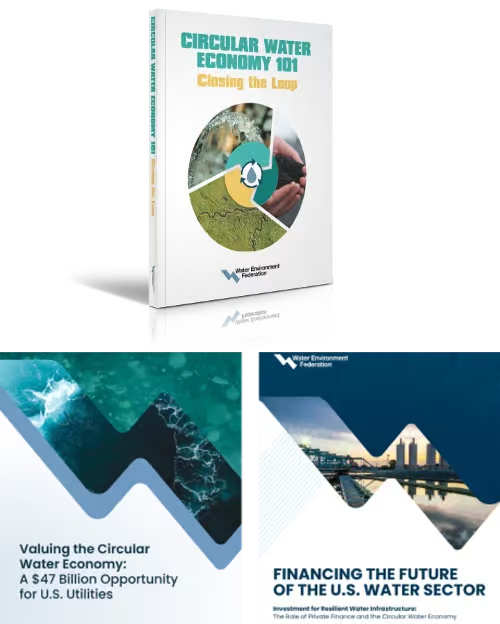
WEF’s Circular Water Economy 101: Closing the Loop provides a comprehensive exploration of the Circular Water Economy centered on Reduce, Recover, and Regenerate.
The book defines each strategy and explores its financial benefits, supporting technologies, and implementation frameworks. It also addresses public outreach and stakeholder engagement, and it uses real-world case studies to show how circular water principles can be applied across diverse settings.
Circular Water Economy 101 Course
WEF also offers an interactive, self-paced Circular Water Economy 101 course covering five modules:
- Introduction to the Circular Water Economy
- Reduce: Minimizing water and resource loss, preventing pollution, and conserving water
- Recover: Exploring technologies and practices that enable resource recovery from water systems
- Regenerate: Looking beyond recovery to ecosystem restoration, climate resilience, long-term sustainability, and equitable access to healthy water environments
- Elevate: Empowering learners to lead, scale, and advocate for circular water solutions
The course takes approximately two hours and 40 minutes to complete. Participants who complete the full course can receive a certificate of completion with 2.6 hours of recommended course credit.
Enroll in Circular Water Economy 101
Explore Circular Water Projects Around the World
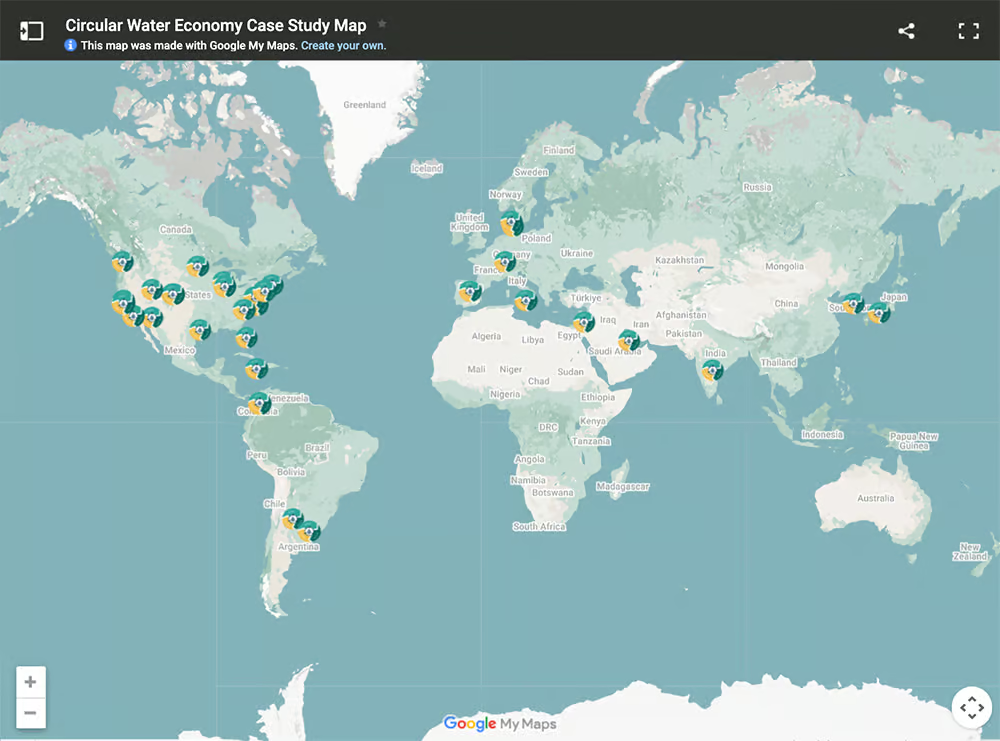
WEF’s Circular Water Economy Interactive Map brings together real-world case studies demonstrating circular practices around the globe.
Projects are organized around the Reduce, Recover, and Regenerate pillars, and users can filter examples by pillar, country, or project type before exploring individual case studies in greater detail.
The map is designed to grow with the sector. Water professionals and organizations implementing circular approaches are invited to contribute project information and help expand the collection of real-world examples.
Explore WEF’s Circular Water Economy resources
Submit a project to the Circular Water Economy Interactive Map
Financing the Future of the U.S. Water Sector
Implementing circular approaches at scale also requires new thinking about how water infrastructure is financed.
WEF’s insight report, Financing the Future of the U.S. Water Sector, examines the investment needed to modernize aging infrastructure and meet growing demands. Alongside traditional funding sources, it explores approaches including public-private partnerships, blended finance models, and asset monetization that can help unlock capital, strengthen resilience, and capture more of the value created through a circular water economy.
Download Financing the Future of the U.S. Water Sector
Experience Circular Water in the Field
WEF’s Circular Water Economy Study Tours give water professionals an opportunity to see circular approaches in practice and learn directly from the utilities, organizations, and communities implementing them.
In 2025, WEF study tours included Denmark, with the Center for Sustainable Infrastructure, and Japan, in partnership with JSWA. WEF also partnered with SABESP for a Brazil Operator Exchange Study Tour that included opportunities to explore circular water solutions.
In 2026, Circular Water Economy study tours have included Costa Rica, led by Global Water Stewardship with a delegation from WEF’s Students & Young Professionals Community; ReWa and Charlotte Water, in connection with the Utility Management Conference; and South Korea, in partnership with Korea Water Partnership.
These experiences give participants the opportunity to observe implementation firsthand, exchange knowledge with water professionals in other regions, and bring practical lessons back to their own organizations.
Learn more about Circular Water Economy Study Tours
Follow Circular Water Across WEFTEC 2026
From technologies and case studies on the exhibition floor to technical education, community collaboration, leadership development, and student innovation, the Circular Water Economy is woven throughout WEFTEC 2026 and wider WEF initiatives.